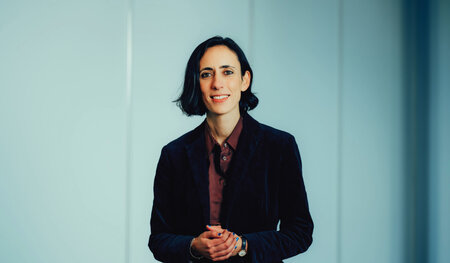
“With Google, Berlin can look back on a decade of AI research.”
Slav Petrov, Vice President, Research at Google DeepMind
InterviewShare on:
The opening of the Google AI Center Berlin marks the creation of a new hub at the intersection of research, industry, and policy. The goal is to foster collaboration and further drive innovation in the field of artificial intelligence. Few people associate the development of AI as closely with Berlin as Slav Petrov, who oversees key aspects of Gemini’s post-training at Google DeepMind and has been involved in the development of the Berlin office for many years.
In this interview, he discusses Berlin’s unique role in the global AI ecosystem, explains why post-training is crucial for the practical application of AI, and offers insights into how advances in multilingualism and multimodal systems are transforming our communication. A conversation about technological foundations, concrete applications, and the question of how research translates into real-world impact.
Google has recently opened the AI Center Berlin in the historic Gropius Building—as a platform for collaboration between research, industry, and government. You have spent a significant part of your life in Germany. What does this opening mean to you personally—and why Berlin?
On a personal level, I have a strong connection to Berlin—I grew up here, and my children are growing up here too. It’s our home. Professionally, Berlin is the right place for me: With Google, the city has a ten-year history of AI research. This is where the foundations for today’s large language models were developed, where AI milestones like PaLM or LaMDA—and now Gemini—were co-developed, and where a longtime Berlin colleague co-authored the famous Transformer paper.
The fact that we are now bringing all these activities—from DeepMind to Research to Cloud—under one official roof with the Google AI Center and creating a physical space for collaboration is a major milestone for this ecosystem. We hope that many more ideas and innovations will emerge here through collaboration.
You co-lead the post-training phase for Gemini, one of the most advanced multimodal AI systems in the world. What exactly does “post-training” mean—and why is this phase so crucial for a model like Gemini?
While the AI’s pre-training imparts general knowledge, post-training is the phase in which we teach it to apply that knowledge in a truly useful and reliable way. Our goal is to make the leap from a simple chatbot to a universal assistant.
In my team, we focus on three things: We train the model to communicate across language barriers, to understand spoken language—including dialects and emotions—and to actively use tools such as browsers or email. That’s what makes the AI suitable for everyday use.
Your work on audio processing, multilingualism, and tool usage reaches billions of users through Google Search, Translate, and Assistant. Which of these areas do you currently consider to be particularly significant?
The convergence of these capabilities to break down real communication barriers. A personal example: My seven-year-old son doesn’t speak Bulgarian, but my aunt from Bulgaria speaks only her native language. Thanks to Gemini, the two of them can now talk directly to each other in real time, using their own voices.
More than half of humanity grows up multilingual. If AI can seamlessly reflect this reality—whether through typing or speech—we’ll stop merely using technology and start truly understanding one another on a global scale.
Researchers in Berlin co-authored the seminal Transformer paper and contributed to important models such as Gemini. What sets Berlin’s research culture apart—and how is the new AI Center expected to build on this legacy?
Berlin’s strength lies in the combination of in-depth academic basic research and the drive to solve real-world problems. The new AI Center is now making this even more visible. We provide the spaces and the minds; the community brings the questions.
With our new AI demo spaces and event areas, we’re building a direct bridge: we’re bringing researchers working on quantum computing or robotics together directly with startups, developers, and established companies. This close integration is designed to help translate Berlin’s AI heritage into practical applications.
You were honored with the ACL Test-of-Time Award in 2023—a recognition that your work has remained relevant for over a decade. In a field as fast-paced as AI, what does it take to conduct research that truly stands the test of time?
I’ve been working on AI for over 20 years, and our focus has always been on building useful tools that people can rely on every day. Consistency in research requires solving problems in a scalable way. For example, instead of manually translating every single fact into every language, we need to develop the right training signals so that a model can learn on its own to generalize its knowledge across all language barriers.
If you lay the foundation correctly, your work will outlast the next hype.
Looking at the European AI landscape: Where do you see the greatest opportunities—and what would it take for Europe to play a leading role in developing the next generation of AI?
Europe’s greatest opportunity lies in its diversity, a strong industrial base, and outstanding research. It makes perfect sense to conduct research on topics like multilingualism right here in Europe, where so many languages are spoken in such a small area. To remain at the forefront, we must bring AI out of the lab and into widespread use.
The potential is enormous: generative AI could generate an additional 440 billion euros for the German economy by 2034. To realize this potential, we need strong partnerships—which is precisely why we are collaborating closely here in Berlin with leading researchers from TU Berlin and TU Munich, as well as with industry pioneers such as Mercedes-Benz, Deutsche Bank, and many others.