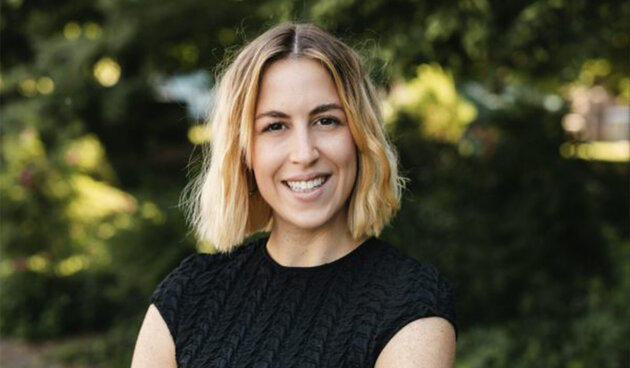
© Dorothea Winter
“The truth of the image is dead. And that’s partly because of AI.”
Dorothea Winter, Berlin University of the Humanities
InterviewShare on:
Deceptively realistic fake images in election campaigns, AI-generated deepfakes of politicians, perfectly staged digital kitsch in our social media feeds—artificial intelligence is changing not only how we produce content, but also how we perceive truth. Dr. Dorothea Winter, philosopher and research associate at the Humanist University of Berlin, conducts research on precisely these questions: at the intersection of AI ethics, democratic theory, and the philosophy of consciousness.
In this interview, Winter explains who bears responsibility for the proper use of AI, why AI-generated images can endanger democratic discourse—and why the question of ChatGPT’s consciousness should not only concern philosophers but has legal and ethical consequences for all of us.
Ms. Winter, AI-generated images and videos are now so good that even experts can barely distinguish them from real ones. You say such content is “extremely useful for populism.” Why is that a threat to democracy?
We have to let go of the idea that we can judge whether an image or video is AI-generated. That in itself isn’t a problem—but it quickly becomes one in a democratic context. For a long time, images and videos were considered evidence: from the Sharpeville massacre in 1960 to the Rodney King case in 1991 to the cell phone footage of the attack in Halle in 2019, they became crucial evidence for democratic public discourse because they make violence visible and drive the process of coming to terms with it. But the truth of the image is dead. And that’s partly because of AI.
And populism knows this, too. Populist communication thrives on powerful images and emotional exaggerations—with the help of AI, a threat can be staged in a matter of seconds, or a statement can be presented that was never actually made. And worse still, when everything is potentially manipulated, it’s enough to sow doubt. For example, if I see an Instagram Reel in which Bettina Jarasch calls for homeless people to be sent to collection camps outside Berlin—a position that clearly doesn’t align with her political stance—I’d likely be outraged by it and might spread disinformation without even realizing it. That is precisely where the danger lies: a democratic and cultural climate is emerging in which the visible, the measurable, and facts lose their evidential value.
In the past, you needed photographers and graphic design teams to create convincing images. Today, anyone can produce deceptively real content on a laptop in seconds. What does this flood of AI-generated content do to our democratic discourse?
Fakes are nothing new—think of the retouched Stalin photographs, Powell’s “smoking gun” images before the UN in 2003, or the slowed-down Pelosi video from 2019. What is new, however, is the speed, scalability, and accessibility of these fakes thanks to AI. AI makes it possible, for example on social media, to generate massive numbers of apparent citizen voices that simulate political majorities, making it easier to orchestrate democratic opinion-forming.
Deepfakes function, in a sense, as “events without an event”: outrage arises before verifiable facts are available. In the context of the 2024 U.S. election, AI-generated images of Donald Trump and Taylor Swift circulated, suggesting political support for their respective camps; in European election campaigns, politicians were attributed statements they never actually made. And ultimately, an “AI gap” emerges: those with AI literacy can contextualize content; those without it believe what they see—and this reinforces existing inequalities in political participation. AI fakes set the agenda and create public sentiment, even if they are later debunked. By then, no one cares anymore.
You call many AI images “kitsch”—easily reproducible, clichéd, lacking depth. Why is this more than just an aesthetic question?
When I describe AI output as “kitsch,” I’m not primarily concerned with questions of aesthetic taste, but rather with a shift in what we perceive as creativity and meaning. AI is particularly good at producing what has already been seen many times—the most probable, the most generic. Depth, ambivalence, and dissonance are missing: precisely what we expect from good images in art, design, and photography.
The AI-generated uniformity has far-reaching consequences; it has a standardizing effect: we grow accustomed to smoothness, immediate comprehensibility, and perfection. The cultural risk lies in the fact that irritation, ambiguity, and political statements gradually lose their value—precisely those qualities that underpin art and, with it, the democratic public sphere.
Social media platforms profit from polarizing content—including AI fakes. Who bears the responsibility—politicians, companies, or the users themselves?
We all bear responsibility. However, not all of us bear the same amount. Responsibility grows with the power to act.
Users have the power (and therefore the responsibility) to determine which content gains reach, which is why media literacy is so important as part of democratic opinion-forming. Yet individual responsibility has clear limits, because individuals can barely grasp digital structures, let alone influence them.
Companies, on the other hand, bear significantly more responsibility because they shape platform design, algorithms, and business models. The philosopher Iris Marion Young describes this quite well: In her model of social connection, responsibility does not arise from direct culpability, but from being part of processes that produce certain outcomes. What matters is who has influence, benefits, and can effect change. Applied to AI platforms, this means that while users are involved, companies and policymakers bear the structural responsibility. Regulation—transparency requirements, labeling of synthetic content, liability rules—creates the conditions ensuring that the digital public sphere is not determined solely by economic dynamics.
In your dissertation, you researched intentionality and AI. Does ChatGPT have consciousness—and why is this not a purely academic question?
Systems like ChatGPT have no intentionality; they cannot think. Intentionality is tied to subjectivity—that is, to the fact that someone perceives, experiences, means, or wants something. AI systems calculate probabilities and generate formulations that appear to convey understanding, but no actual understanding exists.
If we blur this line, we commit an anthropomorphic fallacy—an act of humanization. We recognize this from everyday life: the “nervous” stock market, cars that “don’t want” to start. In such cases, this humanization is completely harmless, because we know that neither the car nor the stock market wants anything. With AI, however, it’s different. Surveys show that young people, for example, develop emotional bonds with chatbots. This naturally has far-reaching consequences for our democratic coexistence—such as when real social contacts are replaced by interactions with AI systems. Or when AI-generated bots are perceived as the voice of “someone” and thereby influence political opinion-forming on social media.
How we answer the question of whether AI systems have intentionality or not therefore has immense implications for democratic theory.
Suppose we were to attribute consciousness to large language models: Would the AI then acquire rights? That sounds absurd—but is it really?
If AI systems were attributed intentionality, we would indeed have to discuss AI rights. The capacity for intentionality is closely linked to responsibility, accountability, and moral status. A system to which its own intentions are attributed no longer appears merely as a tool, but as a potential bearer of rights and duties.
The philosopher David Chalmers argues that advanced AI could develop conscious states—from which moral status would follow, comparable to the graduated rights currently being discussed for animals. The opposing view warns of a growing “responsibility gap”: If rights were attributed to systems, responsibility could seemingly shift to machines, even though their design and use remain determined by humans. Those who attribute intentionality to AI systems are essentially calling for a revolution in current legal practice—I’m not sure if everyone who holds this position is truly aware of that.
What role can Berlin, with its AI ecosystem, play in helping to shape ethical standards?
Berlin can play a special role here because a dense AI ecosystem has formed in the city: research institutions, startups, civil society, government, and culture operate in close proximity and interact easily. This creates spaces where technological development, social reflection, and political regulation can take place together—the prerequisite for ensuring that ethical standards are not only formulated but also tested in practice.
When it comes to AI, interdisciplinary research will be particularly crucial: questions regarding authorship, trust, manipulation, and democracy cannot be answered by a single discipline alone. This can only be achieved through the collaboration of civil society, politics, academia, and business. If Berlin strategically strengthens this collaboration, the city can position itself as the capital of AI ethics—a place where innovation and normative reflection are conceived together.
Thank you very much for the interview.